
The Consultant as a Stoic
As a relatively new member of the management consulting profession, I have spent much of my early career learning its tools and disciplines. Frameworks, methodologies and structured approaches help us bring order to difficult problems. Yet amid that structure, it is worth remembering something fundamental: clients do not engage consultants simply to understand complexity. They engage us to help them decide what to do about it.
Perhaps my interest in this comes from studying philosophy before becoming a consultant. One idea from Stoicism has stayed with me: recognise what lies beyond your control, then focus your attention on what remains within it.
This is not a uniquely philosophical view. In The Effective Decision, Peter F. Drucker writes that effective executives “try to find the constants in a situation, to think through what is strategic and what is generic rather than to ‘solve problems’.”
Explaining management consulting to family and friends can be surprisingly difficult, so I do often resort to describing consultants as ‘brains for hire’ or ‘professional problem-solvers’. But Drucker’s distinction suggests a more useful description of our role. Perhaps our real value lies not in solving each problem placed in front of us, but in identifying what sits behind it, determining what matters most and helping the client decide what to do.
That feels particularly relevant today. Leadership teams are contending with economic uncertainty, geopolitical change, new regulation and rapid technological development. There is always another risk to assess or scenario to consider. Consultants can help clients make sense of this uncertainty, but we must be careful not to add to it. More analysis does not always produce greater clarity.
This is where we need to exercise judgement. “It depends” may be intellectually honest, but it should rarely be the end of our advice. Clients usually know that the evidence is imperfect and that each option carries risk. They engage us to assess those trade-offs and recommend the course of action that offers the best prospect of success. We should not make the decision on the client’s behalf, but we should make our professional view clear.
Ultimately, clients do not bring us in because they want a programme to progress neatly through its phases. Something has prompted them to seek outside help: a difficult decision, an underperforming business or a change that has stalled. Our work should remain focused on improving that position, rather than allowing the process built around the problem to become the work itself.
As information becomes easier to obtain and analysis faster to produce, this distinction will only become more important. Our value will not come from giving clients more to consider. It will come from helping them identify what matters, reach a decision and act despite what remains uncertain.
As someone still early in my consulting career, I want to retain that focus as I learn more frameworks and methodologies. These tools do matter, but they are not the sole measure of good consulting. The real test is much simpler: did we leave the client in a better position than we found them?
Matt Wilding is a Senior Consultant at Forvis Mazars and a Junior Freeman of the Worshipful Company of Management Consultants
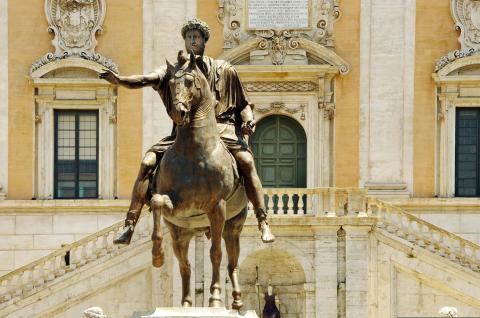
The image shows an equestrian statue of Marcus Aurelius, Roman Emperor and Stoic, courtesy of DEZALB/Pixabay.